Baby Socks and Children Socks look like the simplest items in a young child's wardrobe, yet they are among the most demanding textile products to engineer. A newborn's foot is soft, wet more often than it should be, and constantly kicking. A four-year-old's foot is moving at full speed, sweating inside closed shoes and stretching a sock in every direction. The same knitted tube has to stay in place, avoid pressure marks, absorb moisture, survive hundreds of washes and carry no harmful residue. This page explains how our factory approaches Baby Socks and Children Socks, from fiber choice and needle count to toe closing, grip printing, safety testing and sizing, so parents and product planners can judge quality with real numbers instead of marketing language.
120N–168N
Typical needle count range used for Baby Socks and Children Socks
4.0–7.5
Accepted pH range of finished infant and child sock fabric
≤ 20 mg/kg
Free formaldehyde limit for infant textile products
0.5–1 cm
Recommended sock length allowance beyond the measured foot
Baby Socks and Children Socks: Where the Design Briefs Diverge
The two categories share raw materials, yet the engineering targets are different. Baby Socks serve children who do not walk. Their feet rarely carry body weight, so abrasion resistance matters less than softness, cuff behavior and seam placement. Children Socks serve walking, running and climbing feet. Friction at the heel and forefoot is the main wear mechanism, and moisture from sweat is far higher per unit of foot surface than in an infant.
| Design Parameter |
Baby Socks (0–12 months) |
Children Socks (1–8 years) |
| Primary function |
Gentle warmth, soft contact |
Moisture control, durability, grip |
| Typical needle count |
120N–144N |
144N–168N |
| Cuff design |
Wide, low-tension rib |
Medium-tension rib with firm recovery |
| Toe closing |
Flat linked seam or ultra-low profile |
Linked or reinforced flat seam |
| Typical elastane share |
2%–4% |
3%–5% |
| Reinforcement |
Usually none |
Heel and toe yarn reinforcement |
| Surface treatment |
Plain or lightly patterned |
Silicone grip dots, terry sole options |
| Weight per pair (approximate) |
10–18 g |
18–40 g |
What a Baby Socks Pair Must Do
A newborn cannot tell a caregiver that a seam is rubbing. For that reason the construction has to be conservative. Cuffs are knitted with low tension so the ankle shows no red ring after an hour of wear. The sole is smooth so no texture presses on the pad of the foot. Yarn is soft, combed and low in short fibers, which keeps loose lint away from the skin and out of the mouth of a child who pulls socks off and chews them.
What a Children Socks Pair Must Do
Once a child walks, the sock becomes part of the footwear system. It moves against the shoe lining, so it has to resist pilling and thinning. It also has to hold its shape through repeated wash cycles. Reinforced heel and toe zones, a stable cuff and moisture-wicking yarn blends are the foundation. Grip dots are added for indoor floors, and arch bands are added for sports styles that need a locked-in fit.
Foot Growth Curve and Why Sock Length Matters
A child's foot grows fastest in the first two years. Foot length increases by roughly 4 cm between birth and the first birthday, and by a further 2–3 cm in the following year. Because growth is rapid, parents tend to buy Baby Socks one size up. A sock that is too long folds inside the shoe or bunches under the toes, which creates the same pressure point that a seam would. The chart shows approximate foot length by age alongside the recommended finished sock length for the same age.
Foot Length and Recommended Sock Length by Age (cm, approximate)
The two curves stay close together by design. A sock length allowance of 0.5–1 cm beyond the measured foot gives enough room for toes to spread without creating loose fabric. Between 0 and 12 months the gap between sizes should be small, which is why we cut Baby Socks in narrower size steps than Children Socks. After age three, growth slows and size steps can widen without affecting fit.
Fiber Moisture Regain: The Number Behind Comfortable Socks
Moisture regain is the percentage of water a dry fiber absorbs from air at standard conditions. It explains why one pair of Children Socks feels dry after a school day and another feels clammy within an hour. Fibers with high regain draw perspiration away from the skin surface. Fibers with very low regain, such as polyester, move liquid along the yarn surface by capillary action instead of absorbing it, which makes them useful in blends for fast drying but poor on their own against skin.
Typical Moisture Regain by Fiber (%, standard conditions)
Merino wool15.5
Bamboo viscose13
Cotton8.5
Nylon4.5
Elastane1.3
Polyester0.4
Fiber Profiles for Baby Socks and Children Socks
No single fiber covers every requirement, so most Baby Socks and Children Socks are blends. Each fiber contributes a specific property, and the ratio decides the final behavior of the sock.
Combed Cotton
Combing removes short fibers, leaving a smoother, stronger yarn with less lint. It is the base for most Baby Socks because it is soft, breathable and widely tolerated by sensitive skin. Its weakness is slow drying and low elasticity, so it needs nylon or polyester for strength and elastane for stretch.
Organic Cotton
Grown without synthetic pesticides and processed with controlled dyeing chemistry. Physical properties match conventional combed cotton. The value lies in a cleaner supply chain, which suits newborn lines and families who ask for documented origin of fiber.
Bamboo Viscose
A regenerated cellulose fiber with a smooth round surface and higher moisture regain than cotton. It feels cool against skin, which is why it is chosen for summer Children Socks and for children who sweat heavily in closed shoes. It is less abrasion resistant than cotton, so it is usually reinforced at the heel and toe.
Merino Wool
Fine merino fibers are soft enough for Baby Socks in cold climates. Wool holds warmth even when damp and releases moisture slowly, which prevents the chill that follows sweating. Superwash treatment makes it machine-washable. It is blended with nylon to raise wear life.
Nylon and Polyester
Synthetic reinforcement fibers added at 10%–20% to protect high-wear zones. They improve tensile strength, shorten drying time and keep the sock shape stable after washing. Textured filament versions feel softer than flat filament and are preferred in children's styles.
Elastane
Used at 3%–5% in the cuff and body so the sock recovers after stretching. In Baby Socks, we keep the cuff elastane thread covered by cotton or nylon so it never touches skin directly. Totals above 8% produce a tight cuff that is unsuitable for long wear on small ankles.
Common Blend Compositions
Blend ratios shape the hand-feel and durability of the finished pair. The stacked bars below show the composition our team most often specifies for four product groups.
Newborn Baby SocksCotton 88%PA 9%
Everyday Children SocksCotton 78%PA 17%
Summer Children SocksBamboo 60%Cotton 20%PA 15%
Winter Baby SocksMerino 60%Cotton 20%PA 17%
PA stands for nylon. The dark end segment in each bar is elastane.
Needle Count, Gauge and Fabric Feel
Needle count describes how many needles sit in the knitting cylinder. More needles in the same diameter produce finer stitches, a denser surface and a smoother hand-feel. Finer fabric is also thinner, so it breathes more but resists abrasion less. Choosing the right count is a balance between softness and durability, and the best choice changes with age.
| Needle Count |
Fabric Character |
Best Use |
Trade-off |
| 108N |
Open, thick, rugged |
Winter terry Children Socks, boot socks |
Visible stitch texture, less smooth |
| 120N |
Soft, slightly airy |
Crawling-stage Baby Socks with grip dots |
Lower density than finer counts |
| 144N |
Balanced, smooth |
Core range for Baby Socks and Children Socks |
Moderate wear life in heavy use |
| 168N |
Fine, dense, flat |
Everyday school and dress Children Socks |
Less cushioning |
| 200N |
Very fine, silky |
Occasion wear, thin summer styles |
Needs careful yarn selection to avoid snagging |
Inside a single sock the structure is not uniform. The cuff is a rib, the leg is a plain or mesh stitch, the heel and toe are reinforced pockets and the sole may be terry loops. Each zone is programmed separately on the machine, which is why a well-made sock shows a smooth transition from one zone to the next without tight bands or loose areas.
Toe Closing, Heel Pocket and Cuff Construction
Three construction details decide whether a child tolerates a sock all day or pulls it off in minutes.
Toe Closing
A standard toe seam leaves a ridge across the tips of the toes. A linked seam joins the knitted loops one by one and produces a flat join. In Baby Socks this closing sits just above the nail line, away from the point of contact with the shoe or floor. Children Socks use the same flat join with a yarn reinforcement behind it.
Heel Pocket
The heel is knitted as a separate pocket that cups the rear of the foot. A correctly shaped pocket stops the sock from sliding down and eliminates the "twisted heel" problem. Children Socks use a Y-shaped or rounded pocket with extra nylon yarn to resist thinning.
Cuff Rib
A 1x1 rib gives uniform grip, while a 2x1 rib gives a wider stretch range. Newborn cuffs are knitted at low tension and often finished with a soft fold-over band. Children Socks have a firmer rib so the sock stays up through running and jumping.
Grip Systems on Children Socks
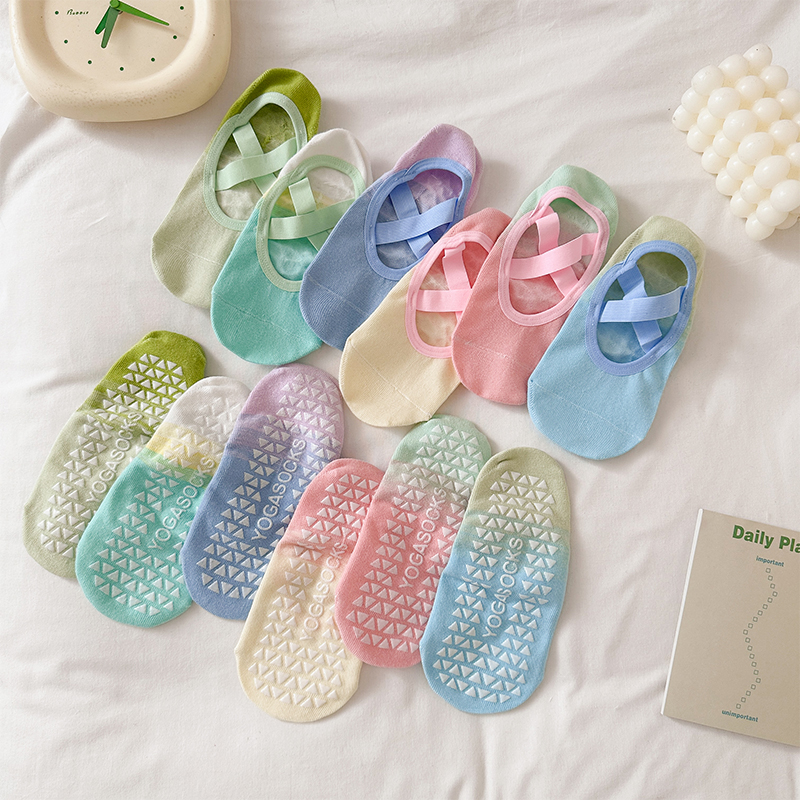
Smooth knitted soles slip on wood, tile and laminate. Silicone grip systems solve this on indoor floors, which matters most at the stage when a child learns to walk. The pattern, density and hardness of the silicone decide both traction and comfort.
| Grip Type |
Appearance |
Traction Level |
Comfort Notes |
| Dot pattern |
Evenly spaced round dots |
Medium to high |
Allows airflow between dots; the most flexible option |
| Line pattern |
Parallel strips across the sole |
Medium |
Directional grip, suits crawlers |
| Full sole print |
Continuous coating |
High |
Reduces airflow; use in thin areas only |
| Character or shape print |
Animal paws, stars, letters |
Medium |
Visual appeal with moderate grip area |
A good grip layer is soft enough to flex with the sole of the foot and bonded firmly enough to survive wash cycles. Silicone that cracks or peels after a handful of washes is a sign of poor curing or an unsuitable base yarn. We test grip adhesion by repeated washing and rubbing, and we inspect the dots for hardness, since a hard dot feels like a pebble under a toddler's foot.
Safety Testing for Baby Socks and Children Socks
Because these products stay in direct contact with skin for many hours, chemical and physical safety checks are part of every production lot. The table lists the main items that our laboratory team monitors, with the reference limits generally applied to infant and child textile products.
| Test Item |
Reference Requirement |
Why It Matters |
| pH of fabric extract |
4.0–7.5 |
Matches the mildly acidic surface of healthy skin |
| Free formaldehyde |
≤ 20 mg/kg |
Limits irritation from finishing agents |
| Azo dyes that release aromatic amines |
Not detectable |
Prevents exposure to restricted dye chemistry |
| Colorfastness to washing |
Grade 3–4 or higher |
Stops dye from transferring during laundering |
| Colorfastness to perspiration |
Grade 3–4 or higher |
Keeps color on the sock when feet sweat |
| Colorfastness to saliva |
Grade 4 or higher for infant items |
Relevant when a baby chews a sock |
| Odor |
No abnormal smell |
Indicates absence of leftover solvents |
| Decorative parts |
Pull force and sharp-edge checks |
Prevents small parts from detaching |
For children under three years, we advise styles without detachable ornaments. Printed patterns and knitted-in jacquard designs achieve visual appeal without any small part that could be swallowed. Fluorescent whitening agents are also avoided in infant ranges, since they add nothing to performance and raise a chemical question that parents prefer not to deal with.
Inside the Factory: From Yarn to Packed Pair
Every pair of Baby Socks or Children Socks passes through a sequence of controlled steps. The numbered cards describe the path in the order it happens on our production floor.
1
Yarn Inspection
Incoming cotton, bamboo, wool and synthetic yarn is checked for count, twist, strength and shade consistency. Yarn that does not meet specification never reaches the knitting floor.
2
Pattern Programming
Size, stitch zones, jacquard artwork and grip positions are programmed into the machine. A first sample is knitted and measured against the size chart before production starts.
3
Knitting
Seamless circular machines knit the sock tube, cuff, heel pocket and toe in one continuous cycle. Operators monitor needle condition and tension throughout the shift.
4
Toe Linking
The open toe is closed by linking loop to loop. Skilled operators and automatic linking units produce a flat join, which is checked by touch and by eye on every pair type.
5
Dyeing and Finishing
Socks are dyed with controlled chemistry, rinsed, softened and dried. pH and fastness are measured on finished fabric rather than on raw yarn.
6
Grip Printing and Curing
Silicone is applied to the sole in the programmed pattern and cured under heat. Dot height, hardness and adhesion are sampled each shift.
7
Shaping and Pairing
Socks are steam-shaped on forms, matched in pairs by shade and size, and checked for holes, drop stitches and loose threads.
8
Needle Detection and Packing
Every packed unit passes through metal detection. Labels, size marks and fiber content are verified before cartons are sealed.
9
Final Lot Check
A sample from each lot is measured for size, weight and stretch recovery, and the result is recorded against the lot number for traceability.
Sizing Guide and How to Measure a Child's Foot
Sizing errors are one of the most frequent causes of poor sock performance. A sock that is too small compresses the toes and shortens the life of the heel pocket. A sock that is too large wrinkles and creates pressure under the shoe. Use the table as a starting point and the measuring steps below for accuracy.
| Age Range |
Foot Length (cm) |
Sock Size Label |
Suggested Leg Height |
| 0–3 months |
7.0–8.5 |
XS |
Ankle or crew |
| 3–6 months |
8.5–9.5 |
S |
Ankle or crew |
| 6–12 months |
9.5–11.0 |
M |
Ankle or crew |
| 1–2 years |
11.0–12.5 |
L |
Crew |
| 2–4 years |
12.5–15.0 |
XL |
Crew or knee-high |
| 4–6 years |
15.0–17.5 |
2XL |
Crew or knee-high |
| 6–8 years |
17.5–20.0 |
3XL |
Crew or knee-high |
1
Place the child's bare foot flat on a sheet of paper, with weight evenly distributed if the child can stand.
2
Mark the tip of the longest toe and the back of the heel, then measure the distance in centimeters.
3
Add 0.5–1 cm to the measured length to find the target sock length for comfortable toe room.
4
Compare the result with the size label. If the foot falls between two sizes, choose the smaller one for Baby Socks and the larger one for Children Socks.
Season and Activity: Choosing the Right Construction
The correct Baby Socks or Children Socks change with temperature, shoe type and activity level. The cards below pair each situation with the construction that performs best.
Spring and Autumn
Medium-weight cotton blends in a 144N plain knit give steady warmth without trapping heat. Crew-height Children Socks protect the ankle from shoe rub during outdoor play, and Baby Socks in the same weight suit a stroller and a car seat.
Summer
Thin bamboo or cotton blends with mesh panels over the top of the foot release heat and absorb perspiration. Ankle-length Children Socks fit low-cut shoes and sandals worn with covered heels, and they dry quickly after washing.
Winter
Merino blends or terry-loop soles trap a layer of air that insulates the foot. Terry should be restricted to the sole and heel, because full-terry socks can overheat inside a heated room. Baby Socks for cold regions should include a snug cuff to hold warmth.
Sports and Active Play
Children Socks for sport use arch bands, cushioned soles and mesh vents. They are knitted slightly denser at the heel and ball of the foot, where impact load peaks, and they use higher nylon content for rapid abrasion resistance.
Customization Services Offered by Our Factory
Our knitting floor handles design, sampling and production under one roof, which means a product idea can move from sketch to physical sample without outside handoffs. The services below apply to both Baby Socks and Children Socks.
Pattern and Jacquard Design
Stripes, animals, geometric shapes, letters and seasonal artwork can be knitted directly into the fabric. Knitted designs do not fade or peel, and they remain flat against the skin.
Color Matching
Shades are matched to a reference swatch or a color code, and colorfastness is verified on the finished sock. Pastel palettes for Baby Socks and bold palettes for Children Socks are both supported.
Fiber and Blend Selection
Composition can be adjusted to the target climate and use. Options include organic cotton, bamboo viscose, merino wool, recycled yarn and moisture-wicking synthetic blends.
Grip Layout
Dot size, spacing and shape can be tailored, from simple round dots to paw prints. Heel and toe zones can be strengthened with additional silicone for active walkers.
Labels and Packaging
Woven labels, printed size marks, hang tags, gift boxes and multi-pair sets are available. Packaging materials can be paper-based to reduce plastic.
Sample Development
Technical drawings are converted into knitted samples that are measured against the size chart, so shape, stretch and hand-feel are verified before production begins.
Product Range Overview
The following product families show how our Baby Socks and Children Socks lines are organized. Each family has a defined fiber blend, needle count and finishing option.
| Product Family |
Age Group |
Core Features |
Typical Needle Count |
| Newborn Soft Baby Socks |
0–6 months |
Organic cotton, flat toe link, loose rib cuff |
120N–144N |
| Crawler Grip Baby Socks |
6–18 months |
Cotton blend, silicone dot sole, stable cuff |
144N |
| Everyday Children Socks |
2–8 years |
Cotton and nylon, reinforced heel and toe |
144N–168N |
| Summer Mesh Children Socks |
2–8 years |
Bamboo viscose blend, vented upper |
144N–168N |
| Winter Terry Children Socks |
2–8 years |
Terry sole, merino or cotton-wool blend |
108N–144N |
| Sport Cushion Children Socks |
4–8 years |
Arch band, cushioned sole, mesh vents |
144N–168N |
Washing, Care and Wear Life
Proper care protects both softness and shape. Fibers react differently to heat, agitation and detergent chemistry, and the care instructions printed on the label reflect the weakest fiber in the blend.
Temperature
Wash at 30–40 °C. High temperatures shrink cotton and weaken elastane, which makes the cuff lose recovery. Wool blends should be washed on a gentle cycle at 30 °C.
Detergent
Use a neutral, fragrance-light detergent. Skip fabric softener on socks with silicone grips, because softener can leave a film on the dots and reduce traction.
Drying
Air dry flat or in shade, or tumble dry on low heat. Direct sun for long periods can harden cotton and fade bright colors, and high heat can damage silicone dots.
| Warning Sign |
Likely Cause |
Recommended Action |
| Thin or see-through toe |
Normal wear on the toe zone |
Replace the pair, as the fabric no longer protects the toe |
| Cuff no longer holds |
Elastane fatigue from heat or age |
Replace the pair; do not stitch a tighter cuff |
| Grip dots peeling |
Softener residue or high-heat drying |
Replace the pair for indoor safety |
| Fabric feels stiff |
Detergent residue or hard water |
Rinse again, and use less detergent |
| Red marks around ankle |
Cuff too tight or sock too small |
Move to a larger size or a looser rib style |
Baby Socks typically need a new size every three to four months in the first year, and Children Socks usually last a full season of regular wear before thinning appears. A pair that shows any of the signs above should be retired even if it is still within the age range of its label.
Common Problems and Their Solutions
Parents often report the same handful of problems with children's socks. Most of them trace back to a specific construction or sizing choice, and each has a practical fix.
Socks Keep Falling Off Baby Feet
Newborn ankles are thin and the foot tapers little from heel to toe, so a standard sock easily slides off. A cuff with a slightly higher stretch recovery and a longer leg height keeps the sock on without compressing the ankle. Matching size to foot length also stops the loose heel that lets the sock rotate.
Children Complain About Seams
Sensitive feet react to the ridge at the toe. A flat linked toe closing, plus a smooth interior, removes the pressure point. Children who are bothered by any seam can choose a seamless-feel construction with a fine gauge and a soft interior yarn.
Feet Feel Damp and Smell After School
Closed shoes trap perspiration, and fibers with low moisture regain keep that moisture next to the skin. Moving to a bamboo or cotton blend with vented zones allows moisture to pass away from the skin. Rotating pairs during the week also lets shoes dry between wears.
Heel Thins Out Within Weeks
Fast thinning means the heel pocket lacks reinforcement or the knitting count is too fine for the activity level. A nylon-reinforced heel and a medium count of 144N give far longer wear for active walkers.
Frequently Asked Questions About Baby Socks and Children Socks
Which material is best for Baby Socks?
Combed or organic cotton is the standard choice for Baby Socks because it is soft, breathable and easy to wash. For colder climates, a fine merino blend adds warmth, and for hot weather, a bamboo viscose blend improves moisture absorption.
How tight should the cuff of Baby Socks be?
The cuff should hold the sock in place without leaving a deep mark on the ankle after removal. A faint, quickly fading line is acceptable. A deep red ring indicates the cuff is too tight or the size is too small.
Do Children Socks need silicone grips?
Grips are recommended for indoor use on smooth floors, especially for toddlers who are learning to walk. They are not required for socks worn inside shoes, where the shoe provides traction, and they are best avoided on socks used in warm climates where airflow matters.
How much elastane should a sock for a young child contain?
Between 3% and 5% gives enough recovery for a secure fit. Higher percentages create tension that is uncomfortable on small ankles during long wear.
What is the difference between 120N, 144N and 168N?
The number reflects how many needles are used in the knitting cylinder. A higher count produces a finer, denser, smoother fabric, and a lower count produces a thicker, more open fabric. The best choice depends on the age of the child, the season and the activity.
Why does the toe seam matter so much?
A ridge at the toe can press against the tips of the toes, especially in closed shoes. A flat linked toe removes the ridge and lowers the chance that a child will remove the sock or complain of discomfort.
How often should Baby Socks and Children Socks be replaced?
Baby Socks need a new size every three to four months in the first year because foot growth is fast. Children Socks should be replaced when the toe or heel thins, the cuff loosens or the grip dots begin to peel.
Can the same sock be worn all year?
Medium-weight cotton blends can be worn in spring and autumn. Summer and winter conditions call for different constructions, since a thin mesh sock gives poor warmth in cold weather and a heavy terry sock overheats a child in warm conditions.
Are decorated socks safe for infants?
Knitted-in or printed designs are safe because nothing can detach. Sewn-on bows, beads and other loose parts are not recommended for children under three years, since they create a swallowing risk.
Develop Your Own Baby Socks and Children Socks Range with Our Factory
Tell us the age group, fiber blend, needle count and design you have in mind. Our team will prepare a technical sample that follows the sizing, safety and grip standards described on this page.



 Dil
Dil